Wednesday, February 16, 2011

Consider Clemntines


I love clementines. I love that they are cute and tiny and you can eat three in a single sitting. I love that they are so much easier to peel than oranges, so you can snarf them down at your desk or wherever you may be without squishing the fruit in the peeling process and making a big ol' mess. I love that they are sweet, never sour, as can sometimes happen with oranges, and you don't have to worry about seeds, either. And lastly, as pointed out in New York Magazine, they are in season now, in February, a bit of citrus-y sunshine in what has been an otherwise beastly cold winter.

Clementines are the tiniest of the mandarin orange family, aw, and are said to originate in the Canton province of China. As they are in season in the winter, as I mentioned above, they are also commonly referred to as "Christmas Oranges," and those funny wooden crates they always come in seem to imply that they would be a perfect present for a vitamin C-deprived friend or someone who is suffering from the winter flu or just the winter blues. While I enjoy clementines as they are, freshly peeled, and sometimes will sprinkle them over a salad, in addition to the neat recipe linked in New York Magazine above, I came across this great recipe from Bon Appetite, and plan on trying it this week! Instead of Chicken Broth, you can sub-out for vegetable stock instead if you want to make it vegetarian (Lent starts this week and a common thing to try is being vegetarian, or so I have found, and this will be a nice thing to try as you explore vegetarian options in lieu of meat for 40 days!)

  • 2 cups low-salt chicken broth (or vegetable stock)
  • 1 10-ounce package plain couscous (about 1 2/3 cups)
  • 1 teaspoon salt
  • 1 1/2 tablespoons olive oil
  • 3 clementines
  • 1 15-ounce can chickpeas
  • 12 large green olives, pitted, quartered lengthwise
  • 6 dates, pitted, diced
  • 1/4 cup fresh mint leaves, chopped

Bring broth to boil in small saucepan. Mix couscous, 1 teaspoon salt, and olive oil in medium bowl. Pour boiling broth over couscous mixture. Stir, then cover with plastic wrap. Let stand 15 minutes.

Peel your clementines; chop peel. It should be easy to peel it with your hand in one nice strip but you can always try with a vegetable peeler if need be, although I feel like then you run the risk of squishing the fruit inside. Cut flesh into 1/4-inch pieces. Combine chopped peel and flesh in small bowl and set aside. You can also just grate the peel if cutting it into mini pieces is too tedious.

Bring chickpeas with liquid to boil in saucepan. Reduce heat to medium and simmer until chickpeas are heated through, about 3 minutes. Drain chickpeas. Gently fluff couscous with fork. Add chickpeas, olives, dates, mint, and clementines. Stir to incorporate evenly. Season to taste with salt and pepper. Bon Appetite also includes a mini-tutorial as to how to remove the "pith" or white stuff that sometimes remains attached to the fruit after peeling, but I like to eat it. It doesn't seem to taste like anything to me, and Chinese folklore says it is an anti-carcinogen, so if you're into that sort of thing, go nuts!

Yummy! And the fact that this also includes dates, so much the better. It would be interesting to try this recipe with straight up figs as well, but dates are perhaps a bit easier to use/not quite so squishy.

Sunday, February 6, 2011

Tastes like Balsamic-Pomegranate Glazed Chicken


I have a tried-and-true chicken recipe that I use over and over again at home. It's simple and I almost always have the ingredients on hand so I can make it on the fly (sugar, soy sauce, garlic and olive oil). But it can't hurt to mix it up every now and again, and a friend of mine passed this delicious recipe onto me. It's almost as quick and easy as mine, and she has just welcomed the sweetest, most beautiful little boy into her and her husband's life, so the fact that she has time to cook something so yummy is a testament to its ease and practicality! Plus, it is healthy, too, and we all know how I feel about pomegranates...

Take equal parts balsamic vinegar and pomegranate juice (POM or some other equivalent) and coat however many chicken piece you like, along with fresh thyme, pomegranate seeds and a bit of olive oil to help coat.

Bake in oven at 350 degrees for about 25 minutes or until done. That's it! The glaze coats the chicken nicely and whatever is left over in the baking dish you can pour over the chicken upon serving.

Wednesday, February 2, 2011

In bounds the rabbit: Chinese New Year Yummies

My Chinese mother is a self-proclaimed banana, which I suppose is a kinder term than "twinkie." Vronsky is a self-proclaimed "egg," so I suppose everything evens out in the end. If you can't figure out what I am referring to here, think colors and pejorative terms for race.

Slang aside, I think there are a lot of "eggs" out there when it comes to food. My favorite part of Anthony Bourdain's Kitchen Confidential was where he decreed that, in all honesty, his favorite, quintessential New York meal was Chinese take-out, Sriracha sauce, a joint and a classic movie. Illegal drugs aside, a part of me truly does think that Chinese food really is the "world's cuisine." I am not kidding. You could find a "Lucky Noodle" in Nairobi and in St. Louis. And while the level of taste at these places could vary widely, from fake Chinese food like orange chicken, to wonderfully authentic, I always smile at the ubiquity of the cheesy fortune cookie and lo mein.

Since Chinese New Year's Eve is this Wednesday and Thursday ushers in the Year of the Rabbit, now's a good time to partake in the omnipresence of Chinese food and try some traditional Chinese New Year treats. Food has such a high standing in Chinese culture itself, the food served on the New Year is filled with tradition and some superstition.

For example, a whole roasted chicken symbolizes family togetherness, while noodles represent long life, so eat them whole and don't break them if you can! And my po-po made sure to remind me to eat some oranges or tangerines tomorrow night and Thursday, which symbolize good luck and Cantonese families will give the fruit to each other as gifts. Too bad I don't have any oranges from her orchard out in Sacramento. Those are the best...always sweet, never sour, and she always peels them for me in a single long peel, like she's done since I was little, because it still impresses me.

Fish also served whole, on the bone, is another traditional treat and done well (nice and thin and crispy) it is absolutely delicious and de-bones very easily. In fact, whole proteins are the M.O. for New Year meals as the act of cleaving meat could be perceived as cleaving family togetherness and unity, a big no-no. As far as your whole fish goes, don't be intimidated by the fact that it comes with the eyes still intact. My grandfather would always tell us to eat it because it would make us wise (all-seeing perhaps) but we never believed him. The fact that he never ate the eye either tipped us off...

Steamed rice cakes are the classic desert. Rice is life, the sweetness symbolizes richness, and the circular shape of the cake itself represents unity. Pomelo fruit is also a classic, but I actually don't care for the taste, but I'll eat plenty of leafy greens and gai lan (Chinese Broccoli), which are also "lucky," to counteract that.

In the moving book Mao's Last Dancer, Li, the protagonist fondly recalls making "jiaozi," or special New Year dumplings with his mother when he was a boy. He grew up in abject poverty in a collective farm in northern China, where "jiaozi" are tradition, and the family would scrimp and save for months to be able to afford enough meat, oil and dough to make the dumplings.

To balance out the excessive feasting that occurs on the eve of the new year, the first meal New Year's Day is traditionally vegetarian. This meat-free meal is also thought to generate good will on that first day as nothing was killed to make it.

The New Year feasting lasts for almost two weeks and you can learn more about each day and what food coincides with it here, but for a half-banana and an indulgent egg, one night of feasting is enough. I plan on making Vronsky's favorite "at home" meal: fresh white rice, steamed lapchong, some sauteed veggies (broccoli, water-chestnuts, snow-peas, ginger and carrots with soy sauce and garlic), and oranges for dessert. And then we will leave all the cleaning for the next day, since it is also bad luck to clean on the New Year, lest you sweep bad luck away. I am convinced that tradition was started by fed-up wives, who themselves were exhausted after the feast and the preparations the night before and needed a DAY OFF before tackling all that mess....

Wednesday, January 26, 2011

As Always, Julia

Vronsky is a very thoughtful fellow. The other day, he was walking by Book Court in Brooklyn, a marvelous independent bookstore I recommend you visit next you are in Cobble Hill, and saw As Always, Julia in the window, which is the entire collection of letters between Julia Child and Avis De Voto, who was a critic, gastronome, and member of the "literati" in Boston/Cambridge, as her husband was a prominent columnist for Harper's and she herself was a well known writer and critic for the Boston Globe among other things at a time when women, as a rule, did not engage in such intellectual pursuits and circles once they were married.

Julia and Avis were wonderful friends, but it would be many years before they first met face to face. The started off as pen pals. It all began when Child, then living in France with her husband, responded to one of Avis' husband's columns in Harper's, in which he bemoaned the fact that he could not find a decent knife in all of the United States. He had to order knives from abroad in order to get the sharpness and strength he needed to be even half-adept in the kitchen. Most of the knives available at the time were simple stainless steel which, although very easy to clean, did not hold an edge to the point where he said they couldn't even slice an apple, and if they were serrated, then you might as well go out and buy a new one. Plus, if he applied any sort of pressure to the handle, like when boning meat or cutting through something tough, like say, a carrot, the knife would actually break off in his hand at the handle.

Contrary to what maybe people believe at the time, dull knives are actually more dangerous. By pushing harder to make a cut, you exert more force and have less control, often resulting in slippage or breakage which could really do some damage. It is just like a fresh versus a dull razor when you're shaving, to use a silly simile, but it is true. When you have to force the knife, the loss of control is when accidents happen.

Anyway, Julia Child responded to this column with a nice note and a new knife straight from France. Avis wrote her a letter in return, thanking her for the knife and inquiring just exactly what she was up to in France, and so the friendship was born.

Reading these letters, it first and foremost causes a pain in my heart knowing that nobody writes beautiful, eloquent, well-though-out letters any more. Sort of like how I wish everybody still wore hats. My friend Sarah and I, still actually write eachother letters from time to time. Real letters, in pen, to bring back the days when we were pen pals from camp. Except we were not at the levels of Julia and Avis, talking about saffron or McCarthyism. Instead, we talked about boys, boys, clothes, and then boys again.

But I digress. Another thing that struck me reading these letters is just how far the American culinary scene has evolved in a generation and a half. There were no fancy pot and pan kits (and certainly no teflon), and clearly there was a dearth of proper knives for the home cook. People probably had a skillet, a stock pot, and a sauce pot or two and that was it. There wasn't a microwave and certainly no George Foreman's. Check out the cover of the book...look at that TINY little oven! And I bet you that the Beef Bourginon coming out of there is absolutely perfect. Even my mom has cribbed off Child's recipe.

And it wasn't even the tools in the kitchen that would seem spare by today's standards. The American palate was so limited. Just imagine: no Chinese food. No sushi or Korean BBQ. No pad thai, tacos, fajitas or Latin food of any kind. Even French food was anathema in the home. Shallots or green beans? Anathema. My dad even drove this point home the other day. His own father worked at the local auto shop in high school growing up, and the shop was owned by an Italian family. Since his own father (my great-grandfather) died very young, my grandpa had no father figure, so the shop owner would frequently invite him home for dinner, where they ate traditional Italian food like spaghetti, meatballs, perhaps some cannellini beans and of course, tomato sauce. Pretty standard right?

For my grandpa, and for others in the town, it was literally the most exotic food they had ever heard of. Sure, it was quite common amongst the immigrant population, but as far as main stream diet? No way. Something outside of steak and potatoes? Madness! I always joke with Vronsky that Chinese food is actually the world's cuisine, but it is hard to imagine a world without Chinese take out, or just a world where no one you know has ever had a dumpling or white rice. Or even heard of such a thing. Forget the fact that pizza is a made-up word and what on earth is an artichoke? I believe that was part of Julia Child's appeal--she opened up a whole new world of food that people could prepare and enjoy on their own, something that is still true today. Sure, most people don't make their own pad thai (although it is easy to make your own peanut sauce), but lots of people use tarragon in their cooking, or eat tofu at home, and cook with soy sauce or garlic or shallots, something that was nearly unheard of before Child. It is no wonder people rarely eat Beet Wellington anymore except at badly catered conferences--as Avis said in one of here letters, "Just the phrase 'Wellington Casserole' sounds unpleasant...at it is!'"

Thursday, January 20, 2011

Terrifying Teflon


I have always taken the "____ Will Give You Cancer" posts that pop up on news-y sites across the internet with a grain of salt, because if you listened to everything that they said (including "turning on the bathroom light in the middle of the night") you would be forced to come to the unpleasant conclusion that life in general is chockablock full of carcinogens.

That said, we live in a toxin-filled world, where harmful things come from even the most benign places. Children's toys, the clothes we wear, beauty products, and food. I don't like it when celebrities get all preachy about the virtues of buying all organic food because let's face it, it is usually more expensive and more difficult to obtain, and not everyone has the financial means to do it, even if they wanted to. And while I try to buy organic/free-range/hormone and cruelty free meat and eggs and diary when possible, I try not to drive myself crazy over it. It is good to remember Michael Pollan's pithy words of wisdom. Eat food. Not to much. Mostly plants.

And yet, what good is organic meat when you're cooking it in a teflon-coating pan? Teflon is scary. I don't think I have ever come right out and said "DON'T DO THIS" but seriously, folks, stay away from teflon. My mom always told me not to buy those "non-stick" teflon pans and stick with all-clad or something similar because if and when something sticks to the teflon, which it always does, when you try and clean it off, the sponge/brush and soap you use will scratch the teflon, leading to little abrasions where food will get stuck and never come out, and it will also flake off into your next meal.

The unsavory and futility of that aside, teflon is highly toxic. How it is still allowed to be used in cooking tools is beyond me. A friend of mine will be writing a more in-depth article on this in an upcoming issue of Health magazine, but this little anecdote she told me last night is truly frightening. If you heat a teflon coated pan on your stove without enough oil to hold in the fume of the burning/heated teflon, and you have a bird anywhere in the house (parakeet, parrot, canary, whatever), within five minutes the bird will be dead. Dead! How do you think people discovered this? Pretty obvious...there were DEAD BIRDS all over people's houses across the country from breathing in noxious fumes!!

If that is not frightening I don't know what is, especially considering the fact that these same people, prior to realizing their beloved pet just died what I can only imagine was a highly unpleasant death, were probably happily making their stir fry or seared fish or whatever and then chowing down on the meal cooked with that very same toxic fume!

I maintain that for most things in life, the ol' ancient Greek mantra of moderation will work for almost anything, but as far as teflon goes, I think I gotta just say no.

Wednesday, December 29, 2010

Snow day treats part II: Consider Sriracha Sauce


While I am on the subject of yummy snow-day treats, I think that a great way to get warm is to eat something hot. And I don't just mean temperature hot, but a burn-your-mouth-and-your-gut-additively-spicy hot, courtesy of Sriracha sauce.

My family has been eating Sriracha sauce since I was in elementary school, and it finally seems to be trickling out into the mainstream. Sriracha has been popular amongst the Asian-American community since the 1980's, and you can now find it in suburban grocery stores and even Applebees serves some sort of shrimp with a Sriracha-infused dipping sauce. When Sam Sifton of The New York Times asked several prominent chefs what they always had in their fridge, Sriracha sauce was right in there, along with eggs, dijon mustard, and full-fat Coca-Cola, in case of hangovers (best cure on the record!). And Sriracha was in this week's New York Magazine's Approval Matrix, which I always find hilarious, yet charmingly astute.

I just snarfed down a delicious bánh mi sandwich at Hinco's in Cobble Hill (Bergen Street & Smith), covered in Sriracha of course, to beat the chill that comes with tromping through slush and snow. Vronsky became addicted to Sriracha after having it every day with my grandparents out in California last spring. It is currently the only thing he has in his fridge, minus a few stray packets of ketchup and soy-sauce. My Po-Pop and Gung-Gung always put it on lo-mein and anything that is leftover. It really will make anything taste better! They say that at their age, nothing has taste like it once did, so the sauce gives it some zip. Po-po also says this is why she only likes to drink scotch versus beer, wine or another sort of liqour, ha. Me too, Po-po. Me, too.

But Sriracha has an interesting back story that helps explain some of its mass appeal. Sriracha is manufactured by Huy Fong Foods and was "invented" in 1984 by David Tran, the founder of Huy Fong, who admits he is both proud of the products popularity and slightly bemused. Hung Foy gets fan mail and fan calls everyday, from people who are suggesting new ways to use the sauce (on multigrain snack chips in lieu of salsa), or a drunk guy who can't even pronounce Sriracha in his current state and just yells "I LOVE ROOSTER SAUCE." (Sriracha's packaging has almost remained unchanged in its 30+ years: clear red bottle, several different languages printed on it, from English and French to Chinese and Vietnamese, all setting off a giant rooster).

Many chefs regularly admit to using it as a "sleeve trick," and Sriracha is now even carried in Wal-Mart after hiding in Asian grocery stores and metropolitan "ethnic food aisles" for years. It is now part of chain restaurants like PF Chang's, and is in food/street meat carts from New York to LA. Yet Tran never had such a broad fan base in his sights when he created Sriracha.

He maintains that he created the sauce with the Asian-American community, especially the Vietnamese community, in mind. He felt that even in America, they would be yearning for hot sauce to put in their pho, the beef-broth and noodle soup that I, too, adore. And yet he did not want to make an exact copy, and drew on many different Asian flavors and techniques. The name "Sriracha" comes from the Thai town, Sriracha, which is know for its home-made chili pastes. And the Sriracha bottle includes serving suggestions for everything from pho to hot dogs, hamburgers, pizza, pasta and sauces to give it a nice bite.

Tran had always toyed with chili and pepper sauces, and when he finally struck on the winning combo of chili, sugar, salt, garlic and vinegar, a world-wide phenomenon was born. People dress up as Sriracha bottles for halloween and their are fan clubs that are hundreds of thousands strong.

I should qualify all of this and say that I am not a huge spicy food fan. I have never really taken to tobasco or jalapeno peppers, yet this is exactly the right kind of "heat" for me. Pick up a bottle today and see if you too will be converted!

Monday, December 27, 2010

Savory snow day treats


For all of you living in California, Florida or more temperate climes, you may have read in the news about the intense snow storms up and down the east coast the past few days. From Charlotte to Boston, there are several inches to almost several feet of snow, leaving many people stranded, hopefully at home at not on a train or subway or airport.

Me? My flight back to NYC was canceled so I have two more glorious days at home, lazing about in my fuzzy pj's, drinking hot tea or a nice malbec (depending on the time of day), reading, and getting creative in the kitchen since no one wants to bother with going to the store.

If you have been a follower of this blog, you already know that my family makes pizza for Christmas instead of a more "traditional" meal. My mom and I favor lots of veggies and tomato sauce with minimal cheese and perhaps just a sprinkling of ground beef sauteed with onions, garlic, ginger, and soy sauce. My dad on the other hand, piles his so thick with peperoni, ground beef and cheese that it takes twice as long to cook and is almost 3 inches high after cooking, when supposedly everything has settled.

Well, there is always an interesting smorgasbord of leftovers once the pizzas have been finished. There's always a plethora of the beef and onions left over, as well as diced peppers and mushrooms and hopefully a tomato or two that hasn't been sliced. Unfortunately, sliced veggies never seem to stay crisp the next day, so we'll either put them in an omelet or make a modified frisee salad. Here is an excellent recipe, courtesy of Saveur. It reminds me so much of what Vronsky and I would eat when we were in Paris. We'd have that salad or haricot vert for lunch each day to make up for the fact that we had had champagne, eggs and lovely rich coffee for breakfast.

We usually don't have any bacon on hand in our house at home, although we always have eggs. If we had bacon, it would be eaten by my dad in one sitting. One year, I got him a "bacon of the month" club membership from Zingerman's, and my mom yelled at me. (Are you trying to kill him or what?!). Fortunately, the ground beef makes a nice substitute, and and the egg and always crisp frisee makes up for the fact that the peppers and tomatoes are getting a bit limp.

I often try to perk the peppers up by soaking them in some cold water for a bit, but the tomatoes tend to be beyond salvaging. If you have any hints, let me know! Otherwise, I just cover them in some balsamic glaze and eat them with a glass of red wine.

I also love making my own hot chocolate, heating some milk, semi-sweet cocoa powder, cinnamon and sugar in a saucepan. I have contemplated melting-down a Hershey bar in the past when we ran out of cocoa powder due to my sister baking enough chocolate cookies with white-chocolate chips and macadamia nuts to feed an army, but my mom said that if I ruined her pan she'd kill me, so I desisted. After all, we're trapped in the house all together, so it is probably best to keep the peace at all cost.

Rice is always in plentiful supply, and we've made a nice dent in our 15 lb sack to eat with my mom's delicious brisket, which takes 2 days to make and keeps for nearly twice as long.

There's also tons of charcuterie lying about, courtesy of several gift-baskets our family had been sent for Christmas, and while we've run out of proper toast points, baguettes and farmhouse bread, I admit that they are not half-bad with a Triscuit! Plus, my mom bought a huge wedge of Manchego cheese and some delicious gouda from the Netherland's to go with it while she bought a dozen bottles of wine as Christmas gifts for various acquaintances.

The one thing missing is a steady supply of fresh fruit. We've worked our way through bananas, our stash of apples, the cantaloupes and the Edible Arrangement Vronsky set to my parents. I suppose we should make plans to venture out at some point though, if only to cash in on the gift cards and take advantage of some sales!

Wednesday, December 22, 2010

Simply the Holidays

A few years ago, Pegasus published a marvelous little book entitled Provençal Cooking: Savoring the Simple Life in France by Mary Ann Caws. I absolutely loved working with Caws on this charming combination of memoir, cook book, mini-travelogue, and philosophical treatise on the joy of living simply.

Complex does not necessarily mean better, whether it is food, prose, art or music. Sometimes the most pleasing meal is one that is the simplest to prepare and maybe only has a few ingredients. When Caws lived in Provence, she lived without electricity in half her house and no plumbing. Needless to say, she had to completely revamp her approach to cooking. It's much easier to make do without a modern kitchen when you are in the middle of the French country side and you can walk right outside your door and partake of the fruits of the earth (and perhaps your neighbors vineyard), versus in, say, a budget NYC apartment, which might have plumbing an electricity, but the stove and oven are patchy at best and your closest thing to local produce is a pack of Marlboros and a bag of Fritos from the vermin festooned mini-market around the corner.

But what I found the most appealing in Provençal Cooking was Caws' call for simplicity. In today's world, almost any one at some point will bemoan the fact that their life is too complicated. They are trying to be too many things to too many people. I have certainly felt that way from time to time, and it usually rears up in instances of feeling inferior because someone else has managed to start a non-profit that is about to spear-head a cure for AIDS, published a collection of poetry, qualified for the Boston Marathon, is a classically trained oboist, a volunteer at the ASPCA, and has managed to bake a pie from scratch and bring it to the church pot-luck. Meanwhile, I'm standing there with a plate full of uneven slice-and-bake cookies because I could not get my sh*t together in time to make anything better.

Perhaps I am the only one who feels this way, yet I have a feeling that I am not alone. It seems like the holidays bring out this feeling more than any other time of year. There is the stress of giving gifts and perhaps preparing the holiday meal. Family can certainly make this worse more often than they make this better, and while there are always pithy little sayings like "Christ is the Reason for the Season" or Linus' monologue that are bandied about to try and calm us down, I find that the best way to savor a bit of simplicity can be through food.

Whether you celebrate Hanukkah or Ramadan or Christmas, if you look back to the basic rituals of these faiths' social foundations, you find an extremely simple meal. Whether it is Jesus breaking the bread and sharing it with his disciples over some wine, fish and challah bread on shabbat, or bread, fruit and stew after a day of fasting, these meals are completely no frills but nourishing in every sense. And they are all meant to be shared with people, as holiday meals are today. Communion is always meant to be taken with your spiritual community, the sabbath meal is traditionally the family's main gathering point for the week, and the sunset meal iftar is an incredibly social occasion, with people meeting at family homes or mosques. There was no prize for who could make the best bread or bring the most exotic fruit. It simply was not the point. You were there to share the food with those you cared about and reflect on what mattered most to you--the simple, often blessed, things that should be remembered but often get lost in the complexity of day to day life.

Remembering the roots of this whole crazy season, no matter what faith, helped me keep my sanity this year more than ever before. Between work, family and social obligations, I had been sleeping on top of my laundry for several days because I literally could not find an hour to put it away. But what made me feel even better than an extra hour of sleep (or even putting my clothes away), was the twenty minutes I spent making icing last week.

Every year my roommates and I host a cookie decorating party, and while my designs are probably the worst of the bunch and I spent most of my time this year trying to keep my new puppy out of trouble, there was something really lovely about standing there, idly chatting over some B-grade white wine, mixing sugar and water. I had not spent any real time with them for weeks, and I had had this nagging feeling for months that my friendships, more than anything else, were being neglected at this point in my life. Wedding planning can do that, but it doesn't mean it should. But finally, here we were, playing with sprinkles and candy cane crumbles, slathering icing onto sugar cookies. It was simple, it was delicious, and it finally felt like Christmas.

Monday, December 6, 2010

The Early Bird Special at Maialino

It is a running joke between Vronsky and me that I like my men like I like my wine: full-bodied and furry. While he's actually on the side of quite slim and really not that hairy, I really do like spicy, tannin-laden wines, and the wine I had tonight at Maialino, the restaurant that is a part of the Gramercy Park Hotel, was just that. It was a Sicilian wine, "Fastaia," and the perfect complement to the Roman cuisine we stuffed our face on at 5:30pm, because we could not get a reservation at any other time.

I was actually alright with that, as my day was so crazy that I literally did not have a moment to eat lunch, so by 5:00 I was starving and the fact that suckling pig was the house specialty was music to my ears. But first, I had to gorge myself on the delicious sampling of bread and olive oil that graced the table. The oil was a bit too salty for my own personal preference, but the bread was so perfect that I actually preferred it alone.

Then came the salumi mista, along with a generous sampling of olives, which Vronsky does not like, so I got to relish them all myself. The salumi station is actually next to the bar, so you could see the meat being sliced with loving care. After reading how salumi was made in Bill Buford's Heat, I appreciate the explosion of taste in each bite even more.

Next, I had the agnolotti di zucca, which was essentially pumpkin ravioli with balsamic and pine nuts. It was delicious, but not not original, and I had a better version of that same dish at another Danny Meyer restaurant, Union Square Cafe. Vronsky's dish however, the bucatini all'Amatriciana, was excellent. The spicy tomato sauce was just that: spicy and tomato-y, and the bucatini was perfectly al dente. There was just a bit of Guanciale to give it some richness that cut the brightness of the sauce a wee bit.

Then came the suckling pig, which is not for the faint of heart or stomach. It is incredibly rich and the fat is almost as thick as the meat. As someone who is used to the Cantonese style of pig or duck in this manner, where the fat is almost completely rendered, seeing that snowy layer of fat just under the crackling was a bit surprising, although it does make everything delicious. In the end, however, I separated the fat from the meat and crackling and went to town. It is rich and flavorful and the roasted brussel sprouts were the palate cleanser.

For desert, we managed to make room for the torta sbrisolona, an almond and apple crumb cake with caramel gelato. Pure heaven for someone who loves anything pie-like, fruity or nutty. Round that off with a bit of espresso, and I can't wait to come back for the early bird special again!

Do not be intimidated by the location of the restaurant. While it certainly is not cheap, it is not necessarily expensive for a night out, as the portions are Continental-sized and served family style, so go with someone who is willing to share and you'll be able to try lots of things within a fair price range.

Next time, I would like to try a different secondi (I can only take suckling pig once every year, if that) and I would also like to try a more authentically Roman past dish, which tend to not be as saucy as the country Italian fare and more egg-based, like the bombolotti alla Cricia, which is pasta, egg, some Guanciale (unsmoked Italian bacon), and pepper. I would also love to try a cheese selection as well...I could scare enjoy my espresso because I was eyeballing the cheese tray of the people next to us, but my stomach was simply too full!

Wednesday, December 1, 2010

Girl crush: Christina Hendricks

Christina Hendricks rules. Not just because she's a great actress, super sexy, and comes off as funny, warm and witty, but she's quite the foodie too! I won't spoil this great interview with New York Magazine's Grub Sreet, but I will pre-empt this and say that I should have a girl-date with her. She likes scotch neat, I like scotch neat. She likes goat cheese, I like goat cheese. She can cook a New Years dinner for 40-50 people, I cannot do that, but would like to hear all about it! Her hubby bakes delicious bread, and Vronsky can make a mean bowl of cereal. See! We're totally destined to be besties.....

http://newyork.grubstreet.com/2010/12/christina_hendricks_drinks_her.html

Tuesday, November 30, 2010

Bountiful Bolivia (and Venezuela too)

I do not know very much about South America or South American cuisine. There is an Argentine place Vronsky and I used to visit in Tribeca, but ever since he moved, we have not had the chance to visit as frequently, although they had the best rosemary lamb chops I have ever tasted, and a killer wine list to boot. I love Chilean wines as well and we have toyed with going to Buenos Aires and then to Chile for our honeymoon (a little culture, a little skiing, a little viewing-of-Penguins), but that is as far as my knowledge of that vast and vibrant continent goes, unless you count the tales of life in Rio that my Brazilian literary sub-agents tell me, in which case, I am packing my bags!

But a literary life on a Brazilian beach in a thong aside, over Thanksgiving, my parents took Vronsky and I to the most charming restaurant in Falls Church, VA, La Caraquena, which features authentic Bolivian and Venezuelan food. My mom and dad love trying new food and La Caraquena had received rave reviews in the Washingtonian and Washington Post and so as a nice pre-Thanksgiving meal on Wednesday night, squeezed into a booth in the petite, but homey, restaurant, and boy, were we in for a treat.

The head chef, Raul A. Claros, based the menu around traditional Bolivian and Venezuelan food, as he he was born in Venezuela to restauranteur parents, and then moved to Bolivia as a young man. The highlight of the entire meal was the Salteñas, which is essentially an empanada on steroids. They are tennis-ball sized "turnovers," and the crust is flavored with a mildly bitter seed called the achiote, but it sets off the flavor of the filling to a tee: robustly flavored beef with diced potatoes, carrots, peas, an olive or two and a chapped egg. I think I could have easily ordered 4 of those as a meal with a nice red wine and been perfectly satisfied.

But then I would have missed out on the arepas, which are the Venezuelan staples on the menu. Arepas are flat, white ground-corn cakes amendable for stuffing, and stuffed they were, as there are close to a dozen fillings to choose from on the menu, from black beans and grated white cheese to "Sifrina" (chicken salad with mayonnaise and avocado, and the "Perico," which is egg with chopped tomatoes and bell peppers. Then there is "JP's Favorite," which was my favorite too: thin slices of garlicky steak with onions and cilantro.

My sister had the peanut soup, which was quite delicious although I don't know if I could have taken an entire bowl of it. I loved their black bean soup, mopped up with some of their yuca fries, and while we were busy stuffing our faces we were also angering our livers with some of their delicious passion fruit or mango margaritas.

After we waddled off home, Vronsky and I were fairly dead set on honeymoon-ing in Bolivia just so we could stuff ourselves with salteñas. While that might not eventually come to fruition (Greece might still call my name), we'd like to keep exploring Latin American, if only on our dinner plates!

There is Boca Chica on 1st Ave near Houston that I have heard is quite tasty, and then there is El Cocotera for traditional Venezuelan food in Chelsea. Industria Argentina is that place in Tribeca that I now have a yen to return to, and if any one has any other recommendations for places in Manhattan or Brooklyn, let me know in the comments! Till then, I'll be pining for those La Caraquena salteñas until I am home again for Christmas.

Thursday, November 11, 2010

D is for Dominate


If you have ever toyed with the idea of running a marathon, please do so! I had such an incredible time last Sunday, I have still not come down from the endorphin rush. It was an experience beyond compare. When Vronsky saw me come up 4th Street around mile 10 in Brooklyn, I had this big dopey grin on my face, one that I held all the way to the finish, fatigue and the fact that I really had to go to the bathroom be damned! If there was any doubt in my mind that New York was NOT the greatest city in the world, then it has surely been eradicated by this point. The way the entire city turns out for the marathon is incredible. From the tip of Brooklyn to the Bronx and everywhere in between, the marathon shows what makes NYC one of a kind. The diversity and spunk is evident for all 26.2 miles. From the elderly deli owner yelling "run faster, my friend!" to the fire fighters and cops, to the little kids holding out their hands for high-fives, flags being waved from every conceivable country, a little Dominican grandma handing out paper towels, hipsters handing out lollipops, gospel choirs, random folks handing out orange slices, and the sheer fact that people are tailgating this thing, complete with cook-outs and bands, never ceased to amaze me over the entirety of the course.

And don't even get me started on the racers! A lot of people were just like me based on outward appearance, relatively fit and looking to go a solid time and challenge themselves. Others were running for a cause, be it the Robin Hood Program, cancer, MS, in memory of someone, injured or fallen soldiers, the causes are endless, each and every one unique and admirable. And then there was Team Achilles, who guided along disabled athletes, from those who were blind or deaf, missing limbs or were pushing through some another, less visible disability. The sheer joy on their faces was enough to bring tears to my eyes, and really made me savor just that much more the cheer of the crowd, the perfectly sunny day, the friends that came out to support me, the feel of the ground beneath my feet. I was even savoring the mushy bananas that the race volunteers were handing off as we turned the final corner into the Park.

But what brought a real smile to my face, besides a triumphant finish in a better than expected time, was a random voice in the crowd shouting out that they couldn't wait to "dominate a pizza." I knew exactly what he meant! I was starving and have remained ravenously hungry for the past 5 days.

Immediately after finishing, I inhaled the two apples that came in our goody bag along with the complimentary Gatorade and water. I then shuffled 10 blocks downtown to Josephina's near Lincoln Center to meet Vronsky and inhaled a fruit bowl and their "tangle of angel hair pasta" that came with a wonderfully tomato-y sauce, covered in Parmesan cheese. To put it succinctly, I dominated it.

A few hours later, after Vronsky and I had finally made it back home, I dominated some Indian food. I was craving some naan and some nice and spicy chicken, lamb and veggie kebabs.

And in the morning? I dominated 3 bowls of Kashi's Autumn Wheat cereal and a banana and barely made it the three hours that stood between me and lunch, which was Building on Bond's amazing "Black Friday" sandwich, which is a delicious Thanksgiving medley of shaved turkey, cranberry sauce, and stuffing. Mmm, mmm, good.

Tuesday I dominated some Korean BBQ and then last night it was the fillet Mignon at 21. Usually I find 21's food much to rich, but I guess when you are inhaling everything in sight and buying candy from those kids that come on the subway and sell you bags of M&M's and candy bars for $1 a pop, a little extra bacon grease on that burger isn't going to thwart you. Today I dominated a bowl of turkey chili for lunch (as well as the leftover pickle from the author I was having lunch with...classy) and a burrito from Chipotle along with a bag of chips and spicy salsa.

I suppose dominating that pizza or a sandwich or the entire contents of one's fridge is just reward after dominating your own fears and your prior notion of what the body can achieve. Even Shalane Flanagan, the American woman who finished second in her marathon debut, said that the first thing she planned to do was have a burger and a beer. I think it is refreshing sometimes to revert back to our most carnal and base attitudes about food. Not all the time, of course, as I think it is equally fun and rewarding to really think about what your eating, from ingredients and taste to how it is prepared (or how you plan to prepare it), and savor every morsel, but there is something about the sensation of stuffing warm pasta into your face like there's no tomorrow that knows no equal.

Thursday, November 4, 2010

Food is fuel!


That is something that I have had hammered into me since I was probably about 12 years old. I was so incredibly skinny that my nickname at home was "Jangle Bones" (J-Bones or just Bones for short) and my swim coach put me on a "milkshake-a-day-plus-instant-breakfast-mix diet" in addition to what I regularly ate, lest my body start to "eat itself." Needless to say, all this turned me off strawberry milkshakes for years to come and don't even get my started on Carnation Instant Breakfast. Yech.

When I get pregnant I'll have to bump up my calorie count some other way. Perhaps I will just sit down and eat an entire roast chicken right out of the pan, a la one of my favorite professors at Princeton who stated this proudly (yet another tick on the very long list of why she is amazing).

But this whole J-Bones era raises an interesting point. In a culture where we are so obsessed with dieting and being thin, I think we forget that food is fuel. I know I wax on and on about it fueling the soul and the psyche, but let's not forget--it's gotta fuel the body first and foremost!

Why talk about this now? Well, after a mad three weeks (Vronsky and I lost a house we were trying to buy, scrambled to find someplace else to live, all with our new puppy in tow, plus the fact that work has been cah-RAY-zay), yours truly is running the New York City Marathon on Sunday! I am more worked up about this than any of the triathlons I've done, perhaps because this marathon will easily take at least four hours, whereas an Olympic distance triathlon, not so much (that's a pic of me from this fall's Nation's Triathlon). But I have wanted to run one for some time now and the day is fast approaching!

I've become more cognizant of the fuel aspect of food in recent months, especially once my runs started getting longer. To complicate things, running is a bit different from swimming in terms of how my body handles food. At the height of swim training back in college, or even high school, I would just stuff myself with anything and everything I could get my hands on, from delicious fajitas to stale cereal right out of the box. It is a fairly common thing for swimmers to do. Andy Potts, now a pro triathlete but former captain of the University of Michigan swim team, stated in Triathlete magazine that he still eats like a college swimmer. In fact, the other day he just sat down an ate a Costco-sized back of peanut M&M's just because he was bored!

For me, my eating habits have had to change a bit leading into Sunday. I'll tend to get a bit of an upset stomach if I eat too close to my long runs, so loading up on the heavier carbs and proteins means must be done the night before, and then I will eat a solid breakfast and a blander lunch than I'd usually have just to be safe, with a cup hot water with ginger, lemon and honey just before I hit the road. It calms the tummy and gives me a last little burst of glucose.

The past week I've made sure that I am getting enough fruits and veggies along with the more obvious carbs and protein. I'll be sticking with variations on my mom's spaghetti sauce and chicken fried rice as Sunday approaches. It is not a time to experiment, but to go with the tried and true.

And while I am a big believe that real food is always the best thing, gels and drink powders do have their place. I've heard veteran Iron Men wistfully recall the days when Gatorade didn't exist and they accomplished miraculous feats in Kona with orange slices, water, and peanut butter M&M's (perhaps Potts was onto something after all!), but I fully admit that I am no Iron Woman. A few well-timed energy "bloks" from Clif (which are just jacked-up gummie squares) and some GU packets will never go amiss in my book. And I'm quite loyal to my Lemon-Lime Accelerade as a drink mix. I find Gatorade and other sports drinks too sweet and when you look at the labels, it's mostly sugar and salt. Conversely, the powders tend to have a lot more vitamins and whatnot, even though I know a lot of people have trouble with the slightly thicker constancy, but I don't mind it, nor the fact that Accelerade is an unearthly bright green color.

I say all this, but I will share one little anecdote in closing that basically negates everything I've just said in the last paragraph. While I was on a long bike ride earlier this summer, I shakily reach into my jersey pocket and pull out a shot block or two, pleased with myself that my cycling skills seem to be improving. I've managed to suck down these little gummies without crashing after all! Just then, a man whizzes by me, and what is he eating to fuel up for a long ride ahead? No goos or gummies for him. He is deftly eating what I perceive to be a turkey sandwich. On wheat bread. With lettuce. I swear I even saw a bit of Dijon mustard.

So the question now is: who will hand me a turkey sandwich (or perhaps a nice piece of pizza) on Sunday??

Thursday, October 21, 2010

Consider figs in Frankfurt


Ah, it is lovely to be back in New York again....

Don't get me wrong, I love to travel and would never forsake a trip to a new place for anything, but I have heard that one of the pluses of traveling is that it makes you appreciate home that much more.

The past two weeks have been quite the whirlwind. I think I've slept in my bed 3 times in the past three weeks. Granted, it has been almost entirely of my own making, and while my Sleepy Bear is probably a bit mad a me, it's been completely worth it.

The Frankfurt Book Fair is always an intellectual rush. To be at the center of the international publishing scene and hear what's happening in countries all over the world is such a thrilling sensation--it always serves to remind me why I am doing this. Unfortunately, it is not a huge gastronomical rush. Not to say that I didn't eat well--I stuffed myself each morning with the buffet breakfast and then with heavy schnitzel and beer each evening--but I never found myself trying something new and exciting.

While I was a bit tired of meat and starch by the end of the trip (I always feel like I come down with scurvy a little bit during the fair, between the heavy party food and the pre-packaged convention center food), the buffet breakfast each morning was superb. And it was not as if we were staying in some wildly plush hotel. I have found that breakfasts at most European hotels are excellent. Whereas in the States you'd have some watery coffee, generic brand OJ and some most Eggo waffles served with egg beaters, European continental breakfasts are first rate, even at the hostels.

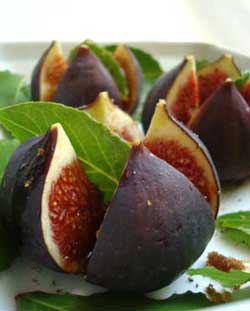
Cured meats and a variety of egg preparations (soft boiled, hard boiled, scrambled or fried), pastries and bread for toast, seasonal fruit, yogurt and various dried fruits and nuts, muesli, a bevy of cheeses, and my favorite of all, figs.

I am crazy about figs. One time I bough my roommate a fig-scented candle for her birthday just so she'd light it and then the entire apartment would smell like figs. Then she decided to keep it at home in Connecticut. Blast!

But seriously, I think figs are tremendously under utilized and appreciated here in America. It takes a trip overseas or mingling with someone from say, Turkey, to bring out the figs and dates. They're so sticky, delicious and integral to human history.

There is the old biblical story of Jesus himself reviving a fig tree (aka a ficus) and Adam and Eve clothed themselves in fig leaves after eating from the Tree, but the relationship between mankind and figs predates Him by a could thousand years. The fig was one of the first plants that were cultivated by humans. Apparently nine fossilized figs from about 9,400 BC were found in a Neolithic village just outside Jericho, predating the domestication of wheat, barley and legumes, and thus fig cultivation might be the first known sign of agriculture.

So, basically, figs and there awesomeness was what brought us down from the trees...and yet they themselves don't travel very well and are rarely served fresh if not grown locally. They are usually dried (as I had in Frankfurt) or candied and turned into dates. That's ok though, and as my primary fruit source in Germany, I was served quite well nutritionally.

Figs are one of the highest plant sources of calcium and fiber. According to USDA data for the Mission variety, dried figs are richest in fiber, copper, manganese, magnesium, potassium, calcium, and vitamin K, relative to human needs. They have smaller amounts of many other nutrients. Figs hare also a good source of flavonoids and antioxidants.

So what to do about figs gastronomically? You can make fig jam and there are ways to make fig reductions and even cocktails that I can only dream about. Ducks are fed figs to prepare them (and their liver) to be made into foie gras. Yet I have only ever enjoyed figs of my own devices dried or fresh, and even in the early jet lagged mornings of Frankfurt, I don't think I'd have it any other way. After all, 10,000 years+ of perfection is hard to mess with....

Sunday, October 3, 2010

Excuses are like assholes...


...Everyone has one, and they all stink. That's a bit of wisdom from the Gastronomical Dad, via the Marine Corps. It's funny, a bit crass, and quite true. It's my dad's birthday, and he himself is quite the food fiend. He introduced me to the wonders that are Coney Island hotdogs, which are not from Coney Island, as one might think, but from Detroit. Go to Athen's Coney in Southfield for a decadent treat: a wiener with all beef chili, spicy mustard and onion served in a hot dog bun. Eat with a fork. It's as awesome as it sounds and recently an editor at Saveur, my favorite magazine, caught onto this too.

My dad is the person who made me wait for blueberry pies after swim practice(so I could enjoy them properly). He has his own personal stash of artisan bread, has been known to bring home a box of cup cakes only to eat off all the tops before anyone else gets to them, and has an epic knowledge of place to get the best anti-pasta and other gourmet goodies. When he made us lunch, PB & J's were anathema--we all got salami sandwiches, sliced extra thick. If we were lucky, we also got a Ho-Ho tossed in alongside our apple.

My mom has waged a 25+ year war against him to eat more fruits and veggies--battle of the Asian diet versus American midwest, and while she's succeeded in part (he now craves edamame), his preferences still run towards kielbasa's and pastrami sandwiches given the opportunity. He's snuck away from business dinners while in NYC for work to go to the Astro diner so he could get a real sandwich and a proper Greek salad. He once gave our dogs rye bread for treats because he thought they might like the taste (he was right....they are now completely obsessed with it and go nuts the minute they here the distinct crinkle of the bag opening).

And despite his affinity for food of the Germanic-Polish-WASP persuasion going back to his childhood, we were eating sushi long before it became trendy in the 90's, he snarfs down Chinese food and was the one who discovered Pho soup, something that has been a staple of our family diet since I was in middle school. Afraid to try new things he is not, and there is another thing I share with my dad when it comes to food: a distrust and dislike of anything even resembling mayonnaise.

While his usual mantra has been cribbed from Garrison Keillor (Be well, do good work, and stay in touch) and other pithy Marine sayings aside, when I first moved to New York, he told me that there was simply no excuse not to eat well in the city. And he is right. There really isn't.

Saturday, September 25, 2010

Delicious Denmark


I had a lovely lunch on Friday with Denmark's reigning "crime queen," Sara Blædel, to celebrate the acquisition of her books for the American market. I decided to take her to the 21 Club in midtown, very "Americana" and a New York classical, although I will come right out and say it: the food is WAY to rich and buttery. It is a favorite of Vronsky's family, so I eat there a fair amount, usually around the holiday season, but lord did I forget about that little tidbit. Everything there has butter, and too much of it at that. The Dover sole was swimming in it. My vegetable risotto was so oily with it it wasn't even clumping up. The burger is literally marinated in it. It's a shame, but I always walk away from there feeling slightly nauseous, although my plum-almond tart was a shining gastronomical delight on the whole affair.

To top off the fact that Sara is an incredibly delightful, charming woman (she and her husband, Lars, could charm the fur off a dog), she brought me a huge bag full of traditional Danish food after hearing through her agent that I ran this here little blog. It was the sweetest gift I'd ever gotten and I dove into this veritable bag of goodies the minute I got home and my meal of butter had subsided.

This bag was like Mary Poppin's carpet bag. Lovely things just kept coming out! A box of chocolates from a Copenhagen chocolatire, some Danish gummy candies, two huge jars of delicious pickled herring (which you MUST eat with slices of raw onion), lovely smoked salmon, and a loaf of thinly sliced black rye bread on which to eat said herring and salmon, and some Akvavit (a strong liquor drink served EXTRA cold).

Pickled herring has been a traditional Danish staple since the Middle Ages, and to this day, it is traditional to have some pickled herring (with onions atop Danish-style rye) for Christmas lunch before any hot dish is served. Herring is referred to as the "gold of the sea" and is also very popular when smoked (but doesn't travel as well as the smoked salmon).

And a note about this Danish rye bread: it is the only thing with which the traditional Danish open faced sandwich (smørrebrød) can be served. It is incredibly dense and sliced very thin and takes more than 24 to prepare and bake. It has a strong smell but it sets of the saltiness and "slimy" texture of the fish to perfection. Don't get me wrong...I love smoked salmon and pickled herring, but it definitely has its own "unique" texture.

Vronsky and I already worked our way through one packet of smoked salmon and half a jar of the pickled herring the next day (I ran out to Trader Joe's and got a giant onion) during the Bowling Green-Michigan game (21-65 Michigan, whee!!). Nothing like a super salty, omega-3 laden brunch to off set Vronsky's birthday party festivities from the night before...I think a trip to Copenhagen is now in order!

But where to find such yummy things in NYC when I've depleted Sara's generous stash? I did some mosey-ing around Whole Foods and Trader Joe's and found some smoked salmon, although I don't know how it will compare to Sara's yet. Pickled herring might be a bit trickier, but there is a shop on 7th Ave. just south of 58th street connected to the restaurant Petrossian that sells caviar and herring and other gastronomical sundries. It is Russian in style, so it will be a bit different from the Danish version, but I have yet to find a place that is more Nordic in focused. Regardless, always eat your herring with raw onion!

Thursday, September 16, 2010

Cheese, cheese and more cheese!


I love cheese and crave it on a regular basis. Hard or soft, creamy or stinky, I have rarely met a cheese I didn't like. Blue cheese on my salad or on a cracker with some walnuts. Camembert. Manchego. I'll eat feta straight up. I just finished munching on a bit of hard, crumbly asiago. There is always something new to try and I never tire of browsing the cheese aisle at Murray's Cheese down in the Village (whenever I rally and get down there from my apartment, otherwise it is Trader Joe's) or thumbing through my monthly Zingerman's catalog. There is an entire UNIVERSE of cheese out there, people. British, Italian, French, Spanish, American...goat, sheep, cow...chesire, blue, gruyére, zamorano, cheddar, stilton...the list goes on! I insisted on trying ever cheese I came across when Vronsky and I were in France, gladly forgoing dessert for the fromage plate. (OK, sometimes I just ordered both...)

People become "cheesemongers" I suppose the same way that people become "wine-o" or oenophiles, if you want to get technical. Cheese, like wine, is alive. And great cheese, like great wine, should be variable. It changes over time. It ages and matures. No wheel should be the same, just as no bottle should be exactly the same. You can get so much from just smelling it and it can evoke anything from freshly mowed grass to nuts and fruit.

In her brilliant and informative The Cheese Chronicles, Liz Thorpe takes the "aliveness" of cheese to an entirely new level. She anthropomorphizes the cheeses that sit in Murrays's case--sitting there like little people--and agonizes that some of the fresh cheese might spoil before someone takes them home. But I can't blame her. She knows who makes these cheeses, from quirky and spunky women in Oregon to accidental goatherds in Vermont, and the intense labor and love that goes into ever wheel.

There are several families of cheese, no matter what kind of milk they are made from (cow, sheep or goat).

Fresh: a high moisture style usually eaten within days of its production. They have a creamy texture, no rind, and a milk, neutral smell.

Bloomy: Classic examples are brie and camembert but include all exterior-mold-ripened cheese. As the cheese is ripening/aging, the spores actually bloom like microscopic dandelions on the outside of the cheese, hence the name "bloomy," although you'd rarely see this by the time the cheese reaches you in the store.

Washed Rind: These are the stinky cheeses. They get their smell from the regular washings in brine (salt water) that can be fortified with booze, yeasts, even butter milk.

Then you have your true rind cheeses: uncooked pressed, cooked pressed, and blue. Uncooked press cheese are aged for two to eight months and are semisoft to firm in texture. Spanish manchego, Italian pecornios and English cheddar are examples of this kind of cheese.

Cooked pressed cheese means that while the curd is being stirred it is cut into tiny pieces and cooked in a vat making it smooth and elastic in texture so that it can age for the long haul. Swiss cheese, gruyére, and Parmigiano-Reggiano are made this way.

Blue cheese is a whole family of cheese, not just the kind that goes on your salad. Like bloomy cheese, the family of cheeses has mold introduced in powder form duringcheesemaking, and it needs oxygen to grow. It is only after the cheese is pierced after it ages that the mold starts to grow and the cheese gets its taste. There are so many "blues" out there outside of mass produced Maytag, so feel free to sniff and experience!

And this is only scratching the surface! I can't even begin to tell you all that I learned reading Liz' book, so go on amazon and get it for yourself! Maybe you'll be inspired and sign up for Zingerman's Cheese of the Month Club. Or buy it for me as a gift....either way, explore cheese that isn't mass produced. We left boxed wine behind in college (at least until New Years, anyway), now it is time to explore the wide, wonderful world of cheese!

Tuesday, September 14, 2010

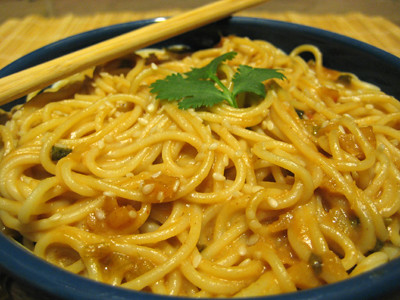
Peanut Butter Noodles


I admit, whenever I eat pad Thai, I am really just using the noodles, lime and mungbeans as a vehicle for the peanut sauce. And yet a lot of pad Thai just isn't peanut-y enough to satisfy my craving (and often, it is a very strong, irrational craving) and so finally, my dear friend Kathleen provided me with a delicious recipe for peanut butter noodles that I can easily make in my own kitchen whenever the mood strikes.

Take half of a box of thin noodles and bring to boil/cook in pot as usual.

For the peanut sauce, you'll need:

2 tbs of soy sauce (the real stuff...not that low sodium imitator)

1 tbs rice vinegar

1 heaping table spoon of peanut butter (make it the delicious Cream Nut brand...you don't need the extra sugar/preservatives for this)

1 tbl Hoisin sauce (this is pretty standard fare now in most grocery stores, but if not, google the nearest Chinese/Asian supermarket!)

1 tsp sesame oil

a drop of chili oil (a little goes a long way otherwise it will get very hot)

1 garlic clove (minced)

Mix all by hand or in a food processor.

Add on chopped ginger, sesame seeds, and chopped scallion to taste.

Then take the whole sauce mix and add to pasta, which by now should be cooked in your pot. Strain, put back in pot, and add this peanut sauce to the hot pot of pasta. The heat will help it coat the noodles evenly. Yummy and quite nutritious.

Serve with some crisp veggies (snow peas is a good choice with shaved carrots and water chestnut) and enjoy!


Saturday, September 11, 2010

Pre-Tri meal


Time to carb-load and fuel up for my triathlon tomorrow! And what better way to do it than a trip to Wegmans, which has taken the DC area (or at least my house) by storm. My mom, dad, sister and I came back with freshly made hummus, French-style salami, lo-mein, bourbon chicken, sauteed green beans, fresh broccoli, cherry tomatoes and cauliflower (for dipping in the hummus, duh), beautiful crisp local apples, marcona almonds and so much more to nosh on as I fuel up for tomorrow morning.

Why stuff my face now? Well, I sometimes tend to get this little thing called "G.I. Distress" before/during long runs and lordy forbid I get one during a race, because G.I. Distress is a very sterile term for a very nasty thing. Anyway, having it tomorrow would really put a crimp in my spandex so to speak, and half the fun of triathlons are swimming/biking/running in a all-purpose spandex uni, so I tend to keep it very simple and fairly light the morning of.

That means a piece of whole-wheat toast with a bit of butter, a glass of OJ and a banana when I leave the house and then nothing but my Accelerade (the most effective sports drink powder that doesn't taste like chalk...I like the Lemon Line and drink it all through my training as well as on race day) and those gummy chews "Blocs" that are organic and made with brown rice syrup for a bit of last minute carbohydrates right before. And water. Lots and lots of water. The Accelerade makes it a bit easier to gulp down so much water during transitions without feeling nauseous, and all the electrolytes, etc. it has in it helps too.

But for tonight, we feast! I'm busy eating matzoh bread with the delicious Cream Nut peanut butter I love so much, plus a bit of honey. It's making the pugs crazy but they are getting fat so my mom says they are not allowed to have any more treats....I might let them lick my peanut butter spoon later though when she isn't looking!

Wednesday, September 1, 2010

Roger Ebert: Courageous Soul with a Rice Cooker


Many of us probably best remember Roger Ebert for his film reviews in the Chicago Sun Times and when he retired, probably never thought anything of him ever again. Well, regardless of what you may have thought of his media personality or his criticism, you cannot help but feel a tremendous amount of respect for his courage and joie de vive in how he has handled his battle with jaw cancer as portrayed in this New York Times article last week.

You see, Ebert had to have his entire lower-jaw removed due to a malignant tumor, and while he is no longer able to speak or eat despite several attempts to rebuild his jaw, he has now turned to food writing and is an avid cook in his Michigan home. "Food for me is in the present tense," while "eating" is in the past. He says he has a "voluptuous food memory" that is growing ever day, in spite of (or perhaps because of) the fact that he can now no longer taste anything. Shortly after he was no longer able to eat for good, he found that his taste memory of certain things were surprisingly strong and peculiar. He had an intense "root beer" period, followed by candy cravings, and every meal he ever at at the "Steak N' Shake" of his childhood.

Ebert did not have the proverbial "last meal," because he didn't know at the time that the doctors would not be able to restore his ability to taste and eat, but for me personally, I don't know how he (or I) could ever choose the "last meal" you could ever taste. And would it really matter? I would probably choose my mom's spaghetti with green peas and fresh watermelon and blueberry pie , all things I have had countless times before and already have extremely vivid memories of, both in terms of taste and broader nostalgia.

And that is what Ebert actually really misses. The wider context of eating. Laughter, jokes, earnest conversation. The camaraderie of eating. Because food as an experience is so much more than taste, it's who you're with, where you are you, perhaps even the peripheral smells. Crisp pink lady apples on an equally crisp fall day? Your memory of that moment will be forever intertwined with that specific autumn smell of burning fires, fallen leaves and whatever else gives that time of year that wonderful aroma. If I could bottle it I would! And of course, perhaps your tromping through the crunchy leaves munching your apple with someone special. Or a furry friend.

Ebert might not be able to enjoy this camaraderie in the traditional sense, but forever undeterred, he's persevered in the most incredibly inspiring way possible. He has written a book (always an A+ move in my mind) about his rice cooker. That's right, people. He has not just written an ode to his write cooker on some blog, he has written an entire book called The Pot and How to Use it: The Mystery and Romance of The Rice Cooker. You see, when Ebert was on the road writing in his early days as a critic and journalist, he got sick of eating crappy room service food and/or the same old diner food every week, so he got creative and started hauling his "pot," or rice cooker, along with him, and learned to cook a myriad of meals in his room while he worked. Plus, it's a hell of a lot healthier, too.

It's a wonderful machine and even I am shocked as to how many different things you can prepare in "the pot." Ebert has a devoted following on Twitter and Facebook and has learned even more recipes from his readers and fans, giving him back a bit of that camaraderie he misses. He still cooks meals for his friends and family in his pot because he's made so many meals in it over the years, he knows the recipes by heart and does not need to depend on tasting and smelling as he goes, something all of us home cooks surely take for granted. He makes everything from sauces to soup, stews and full scale entrees.

At the close of the article, he's preparing some sort of pork dish while his wife, Chaz, a lawyer who also loves to cook, prepares Ebert's Isosource, the nutrient mix that keeps him alive via his feeding tube.

While he’s in the chair "eating," she tends to the pot. After about 15 minutes he walks out and scribbles her a note asking if the pork was cooked properly, followed quickly by an apology.

“I come across as a tyrannical chef because I never speak and am in a hurry because of my shoulder.”

No worries, chef, she says, and lifts the lid from the pot. He pours a little spicy Saigon Sizzle sauce from a bottle and stirs it in. He gives the thumbs up, and it is time to eat.